Continuous, auditable evidence that your AI is performing as designed. Deployed on-premises. Your data never leaves your network.
On-Premise | Zero Data Egress | Air-Gap Capable | Aligned with Industry Regulations
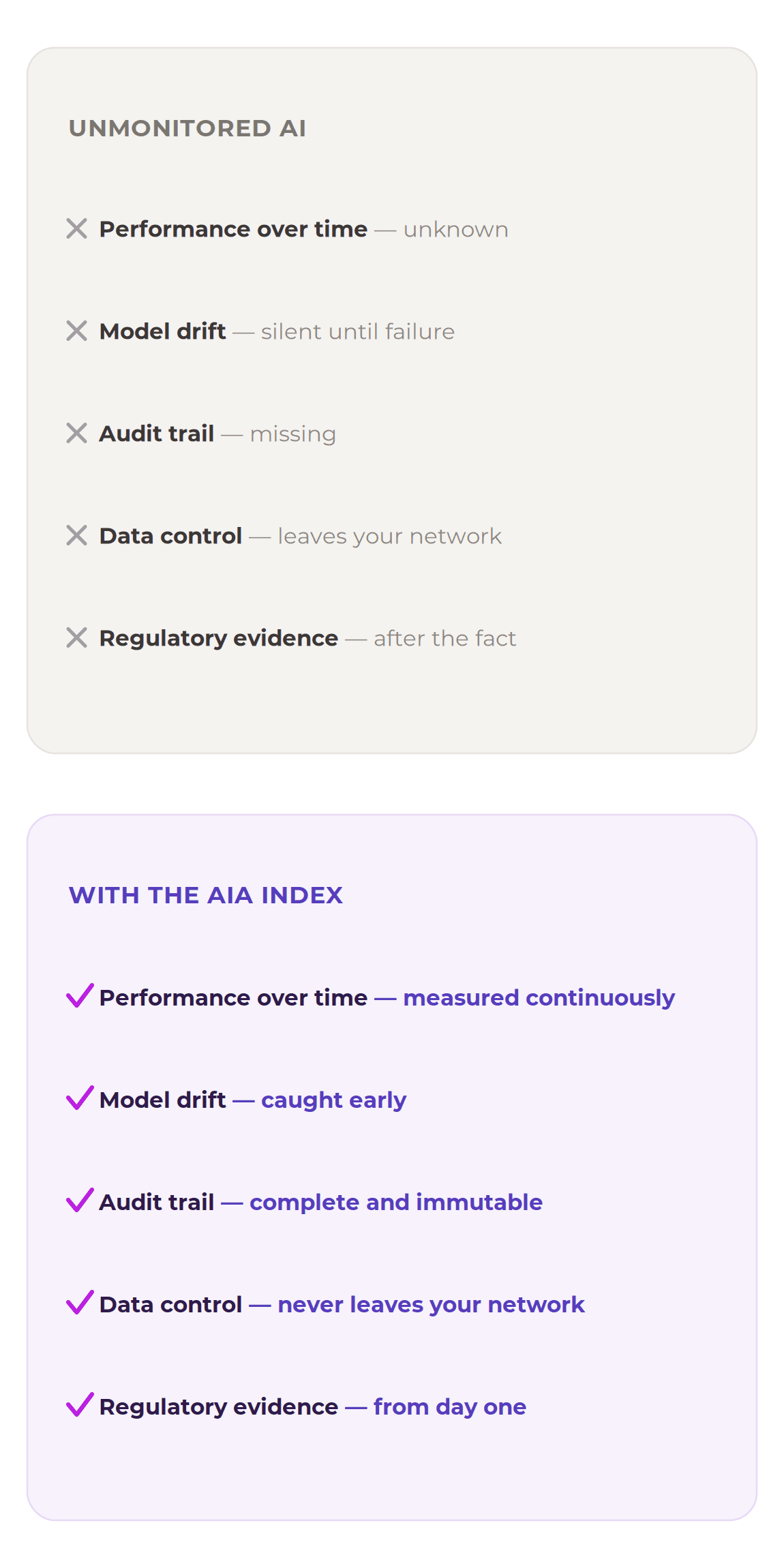
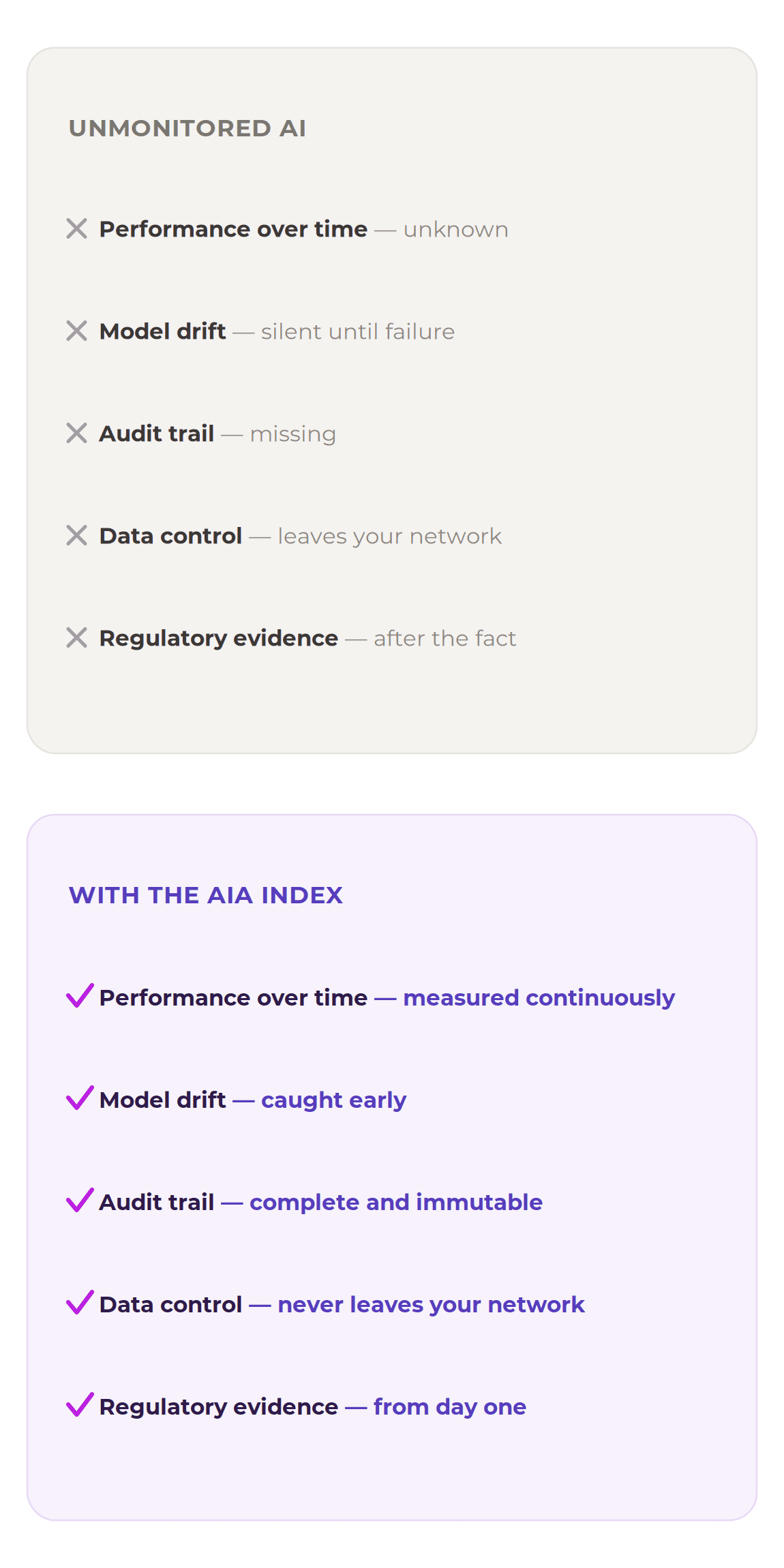
The gap between deployed AI and defensible AI is wider than most realize. Without continuous measurement, you cannot know if your model still performs as designed or has drifted into liability.
We close that gap, and give your leadership, auditors, and regulators the evidence to trust it.


What exactly does AI Assurance do?
AI Assurance helps organizations in high-stakes industries operate AI safely, accurately, and at measurable performance standards.
We work across the full AI Value Chain, offering six service lines: Strategic Advisory & Development, AI Governance, Data Sourcing & Preparation, Model Development & Training, AI Compliance, and AI Performance Monitoring.
Our founders are industry domain experts in healthcare, engineering, and infrastructure, which means we add value at the business and strategy level, not just the technical layer.
Why is "AI Assurance" important for my industry (Manufacturing, Healthcare, Engineering, Infrastructure)?
In industries where decisions have significant impacts on safety, patient outcomes, infrastructure integrity, or scientific accuracy, unreliable AI can have serious consequences. AI Assurance ensures your AI systems are:
Reliable: They consistently produce accurate results.
Fair: They don't introduce harmful biases.
Compliant: They meet industry regulations and ethical standards.
Transparent: Their decisions can be understood and explained.
This builds trust, mitigates risks, and helps you achieve your goals responsibly.
How does AI Assurance monitor the performance and quality of AI models?
The AIA Index Monitors AI models across 30+ metrics and four composite scores:
Model Reliability: Is it running.
Trust and Quality: Is it right.
Audit and Governance: Are you accountable.
Remote Labor Index: Is it delivering value.
Each draws on deeper measurements including drift, failure rates, and distribution shift. Automated alerts and reports let your team act before problems hit operations, compliance, or patient care.
How does AI Assurance measure the quality of AI outputs in complex domains like healthcare, engineering or manufacturing?
Our founders are industry domain experts, not general technologists. This means we don't just assess generic AI accuracy. We understand what good performance actually looks like in your specific field.
For healthcare, we evaluate AI across the full range of use cases your organization depends on, from clinical decision support and diagnostic tools where patient safety is paramount, to revenue cycle and administrative AI where accuracy and efficiency drive operational performance.
For engineering and infrastructure, we understand the precision requirements of structural, operational, and safety-critical decisions.
In both cases, our AI Performance Monitoring service establishes clear baselines, tracks performance across 30+ criteria, and flags degradation before it affects outcomes
If our organization uses AI for predictive maintenance, how does AI Assurance ensure those predictions remain accurate over time?
Predictive maintenance AI is particularly vulnerable to performance drift because the real-world conditions it monitors are constantly changing. Sensor data patterns shift, equipment ages, and environmental factors evolve, all of which can silently degrade a model's accuracy.
AI Assurance addresses this through continuous monitoring across three key areas:
Data drift detection: Identifying when the input data your model is receiving has shifted from the patterns it was trained on
Performance degradation tracking: Catching declines in prediction accuracy before they result in missed failures or unnecessary maintenance
Anomaly detection: Flagging unusual patterns in model behavior that may indicate emerging issues
We provide automated alerts and regular performance reports so your team stays ahead of degradation and your predictive models remain reliable over time.
My firm is new to AI. Can you help us figure out where to start?
Absolutely! Our Strategic Advisory services are designed for exactly that. We work with you to understand your specific challenges and opportunities, identify the most impactful AI applications for your business, and develop a clear roadmap for AI adoption that aligns with your core business goals.
How can AI Assurance help our organization implement AI without disrupting current operations?
Our Strategic Advisory approach focuses on practical, phased AI integration. We assess your existing workflows and systems, identify where AI can provide the most value with the least disruption, and help you design and build solutions that fit your operational environment.
We emphasize building internal capabilities and ensuring a smooth transition so your team can confidently embrace AI as a powerful new tool.
With all the new AI regulations, how can we be sure our AI solutions are compliant?
AI regulation is evolving quickly across multiple frameworks simultaneously, including FDA guidance medical devices, the EU AI Act, FERC, SOC2 and a growing number of state-level AI regulations.
AI Assurance helps you stay ahead of this through our AI Compliance service, which includes:
AI inventory and risk assessment: Identifying all AI tools in your organization, including shadow AI (tools employees are using independently) and mapping them against applicable regulatory requirements
Compliance gap analysis: Documenting where your current AI deployments meet standards and where exposure exists
Governance framework development: Building the policies, documentation, and oversight structures regulators and auditors expect to see
Ongoing compliance advisory: Keeping your program current as regulations evolve
The goal is not just to pass an audit, but to build a documented, defensible AI program that demonstrates responsible governance to your board, your regulators, and your clients.
What are the biggest risks of using AI in high-stakes fields like healthcare, manufacturing or engineering, and how do you help manage them?
In high-stakes environments, AI failures aren't just technical problems, they have real consequences for patient safety, structural integrity, operational continuity, and regulatory standing. The most common risks we see are:
Model drift: AI performance degrades silently over time as real-world data shifts away from training data, leading to increasingly inaccurate outputs
Shadow AI: Employees adopt AI tools without leadership's knowledge, creating ungoverned risk that organizations don't even know they're carrying
Lack of auditability: When an AI-assisted decision is questioned, organizations can't produce documentation showing the model was performing correctly or that appropriate oversight existed
Regulatory exposure: Deploying AI without a governance framework creates liability under the EU AI Act, FDA device guidance, NIST, SOC2 and state-level AI regulations
AI Assurance manages these risks through a combination of AI Performance Monitoring to catch drift early, AI Governance to establish oversight structures, and AI Compliance to ensure your program is documented and defensible.
The goal is to give your leadership team confidence that the AI your organization depends on is performing as expected, every day.